
Raise a critical thinker
in an AI world.
AI can generate convincing answers in seconds. Mind Merit trains students in a skill AI cannot replace: reading with a critical eye, questioning claims, and spotting when reasoning falls apart. It adapts as students improve, so practice stays challenging without feeling overwhelming.
 Earn diamonds🏆 Collect badges✨ Seasonal Quests
Try it yourself.
Sample a few questions. Spot the flaw to defeat its Fallacy Foe.
The bank manager promised my savings account would earn interest. But honestly? I find everything about banking mind-numbingly dull. It holds no interest for me whatsoever. So the bank manager clearly lied to me.
What's the flaw in this reasoning?
Two skills. One sharper mind.

Argument Sorter
Every argument makes a claim and offers evidence for it. This track trains you to pull the two apart — spotting exactly what's being claimed, and what's supposedly backing it up.

Flaw Hunter
Not all reasoning holds up. This track trains students to spot where an argument breaks down, across 25 named logical fallacies, even when the conclusion sounds convincing.
Master both, and you can take apart any argument. Yours, a friend's, or an AI's.
Students earn diamonds and unlock companions as they go, so practice feels like progress, not a worksheet. New themed challenges keep things fresh throughout the year.
Clear insight into how your child thinks.
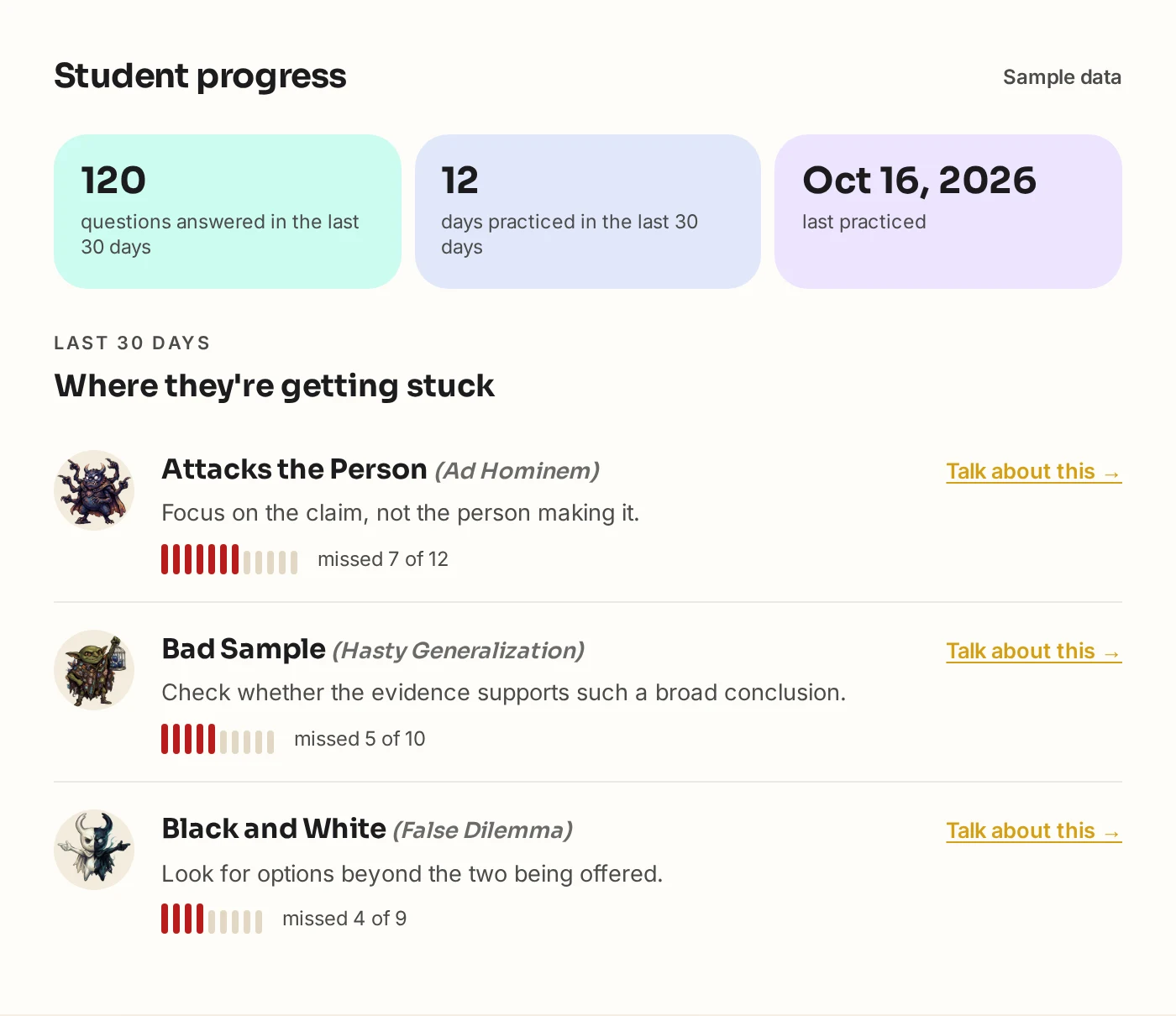
Identifies top reasoning blind spots
See your child's top three missed fallacies from the last 30 days, alongside how often each came up and was missed. A fallacy needs at least five attempts before it appears, so you can focus on patterns rather than one-off mistakes.
Parent guides for the fallacies they're missing
When a guide is published, your child's progress view links straight to it. Explore scenarios, explanations, real-world examples, and a Family Conversation Starter. Guide coverage is growing as more lessons are published.
Adaptive practice that scales automatically
Difficulty adapts to the student, not an arbitrary grade bracket. Fun, accessible arguments build confidence for younger readers, while older students tackle more nuanced arguments.
A 10-minute daily routine
No lesson planning, no printing, and no grading. A self-paced daily practice habit that works smoothly on any phone, tablet, or computer.
Weekly Real-World Examples for Family Discussion
Every Monday, your student gets one documented example of flawed reasoning drawn from history, advertising, science, or politics, chosen for their grade band. They read or watch the story, learning how flaws can play out in real life, and earn 10 diamonds for studying the weekly real-world example. You see the same example on your dashboard, with the flaw identified and a link to the full guide, so the conversation at home starts informed.
Ignaz Semmelweis
If a man is insufferable, are his conclusions wrong?
In the 1840s, physician Ignaz Semmelweis worked at Vienna General Hospital, a facility with two distinct maternity clinics. In the clinic staffed by doctors and medical students, approximately 1 in 10 mothers died of childbed fever. In the clinic run by midwives, the mortality rate was less than 1 in 25. The crucial variable was that doctors frequently arrived at deliveries directly from performing autopsies, whereas midwives did not. In 1847, Semmelweis mandated that the doctors wash their hands in a chlorine solution. Mortality in his clinic plummeted from 18 percent in April to roughly 2 percent by that summer. He later replicated these empirical results at a hospital in Pest, Hungary.
Despite this evidence, the medical establishment largely rejected his findings. Part of this resistance was theoretical: the germ theory of disease had not yet been established, leaving Semmelweis unable to offer a biological mechanism to explain *why* his protocol worked. But part of it was social. His claims offended the sensibilities of the era, implying that educated professionals were the carriers of a fatal disease. In America, the prominent obstetrician Charles D. Meigs, rejecting a similar warning from Oliver Wendell Holmes, is widely quoted as saying that *doctors are gentlemen, and gentlemen's hands are clean.* In essence, many physicians let their own social standing outweigh the data.
Faced with this resistance, Semmelweis grew notoriously combative. In open letters, he publicly denounced his critics as murderers. Many of his critics answered in kind, going after the man and his book rather than his numbers, with one reviewer mocking his text as "the Koran of puerperal theology." This is the hazard of the *ad hominem* fallacy: to the extent that the medical community let its distaste for Semmelweis's abrasive personality shape its evaluation of his clinical data, it was reasoning badly. The mortality rates, of course, were entirely independent of his character.
Evidence indicates critical thinking must be explicitly taught.
Two meta-analyses spanning hundreds of studies reach the same conclusion: students don't absorb critical thinking on their own; it has to be taught on purpose, and it improves most when they practice on real arguments rather than memorizing rules. Mind Merit is built on that approach.
Studies analyzed (Abrami et al., 2008)
In a landmark meta-analysis spanning over 20,000 learners, researchers found that critical reasoning rarely develops through general exposure alone. As the authors put it, improvement "cannot be a matter of implicit expectation." It has to be taught explicitly, with the deliberate practice you would expect for reading comprehension or long division.
Tested interventions (Abrami et al., 2015)
A follow-up meta-analysis evaluated what actually produces measurable gains. The largest gains came when students evaluated authentic dialogue, identified specific flaws in concrete arguments, and received targeted feedback.
Abrami et al., Review of Educational Research, 2008 and 2015. Mind Merit reflects the approach these reviews support; it has not itself been the subject of a controlled study.
For US educators and parents: aligned to Common Core, grades 4 to 12.
The reasoning Mind Merit teaches matters anywhere in the world. For US educators and parents, here's exactly how it maps to one continuous thread of the Common Core, Reading: Informational Text, Standard 8, which runs from grade 3 to grade 12 and asks students to trace, evaluate, and test the soundness of reasoning.
Every student plays both tracks from day one. Difficulty adapts to the individual, not the grade level.
Grades 4 to 5 (Ages 9–11)
In grades 4 to 5, Standard 8 is about learning to identify argument structure: explaining how an author uses reasons and evidence to support particular points in a text.
Argument Sorter
Grade 6 (Ages 11–12)
Trace and evaluate the argument and specific claims in a text, distinguishing claims that are supported by reasons and evidence from claims that are not.
Both tracks
Grades 7 to 10 (Ages 12–16)
Evaluate whether reasoning is sound, spot irrelevant evidence, and name fallacious reasoning — almost verbatim what Flaw Hunter does across its fallacy types.
Flaw Hunter
Grades 11 to 12 (Ages 16–18)
Evaluate reasoning in seminal texts. Mind Merit builds the transferable skill; pair it with primary-source reading for the genre.
Real-World Applications
Download the full standards-alignment sheet (PDF)
Standard text copyright 2010 National Governors Association Center for Best Practices and Council of Chief State School Officers. Mind Merit is an independent supplement and is not affiliated with or endorsed by the standards' authors.
Parent questions.
What age range is Mind Merit designed for?
Mind Merit is built for students ages 10 and up (Grades 4 to 12). Questions require students to pull arguments apart mentally and evaluate logical validity. Because this demands both reading fluency and abstract reasoning, we do not recommend the platform for younger children, even advanced readers.
Why focus on argument structure and flaw identification instead of basic reading comprehension?
Standard reading comprehension tests whether a student recalls what a text said; critical analysis evaluates whether the argument holds together. Cognitive science demonstrates that students frequently focus on surface storytelling rather than underlying logic (Willingham, 2007). Mind Merit trains explicit metacognitive evaluation (Halpern, 2014), teaching students to isolate claims, weigh supporting evidence, and systematically spot invalid reasoning.
How does this help students evaluate AI-generated content and modern media?
Generative AI and modern media produce fluent, confident language that is frequently unsound or ungrounded. Mind Merit trains students to look past stylistic polish and evaluate underlying validity, learning to catch flaws like irrelevant evidence, hasty generalizations, false causes, and circular claims, among dozens of other deceptive reasoning structures, before accepting a conclusion.
Does this replace our curriculum?
No. Mind Merit is a 10-minute daily supplement that supports whatever reading, writing, or logic work you are already doing. Much like daily math drills build arithmetic fluency, regular practice spotting flaws turns critical evaluation into an automatic mental habit.
Can my children share one subscription?
The Family plan covers up to 6 students, each with their own individual profile, progress tracking, and collection. Solo plans cover one student.
What if it doesn't stick?
Every plan starts with a 7-day free trial, and you can cancel anytime with one click from your account dashboard. No hidden fees and no in-app purchases.
Do you show ads or sell student data?
Never. Mind Merit is completely ad-free, and student data is never sold or shared with third-party advertisers.
Start the habit this week.
Ages 10+ (Grades 4–12). Adaptive difficulty. 7 days free, then from $6.99/month.
Start free trialExplore free lessons or download our printable fallacy worksheets.